oday we concluded the Argus Fertilizer Africa Conference, a high-impact gathering that brings together the full fertilizer and agricultural input value chain across Africa—fertilizer producers, traders, importers, blenders, distributors, logistics companies, agribusinesses, financiers, and policymakers—with a shared goal: make fertilizer supply, affordability, access, and usage more effective for Africa’s farmers.
The conference is practical and business-focused, built around three core outcomes:
For me, this was my first time attending. But it immediately became clear that this is not just another conference—it is the kind of platform where serious stakeholders meet, align, and move capital, inventory, and distribution decisions. Most importantly, it is the kind of environment where you can finally sit with the partners you have been trying to reach for a long time—especially when your company is entering a new growth phase and needs stronger commercial linkages.
And that is exactly where MazaoHub is right now.
MazaoHub has been accelerating a strategic pivot: becoming a more data-driven, field-executed platform, supported by a disciplined human network on the ground.
We call this model Tech and Touch.
At the heart of our pivot is a simple belief: If you cannot measure what is happening on farms—input use, timing, conditions, and outcomes—then you cannot optimize productivity, distribution efficiency, or climate-smart impact.
That is why MazaoHub is building an integrated intelligence system that connects decision-making from the farm level up to the private sector and value chain.
MazaoHub’s platform is built around four interlinked “intelligence” layers:
We generate actionable insight from soil diagnosis and soil test information—supporting better nutrient planning and fertilizer recommendations.
We translate soil and crop diagnostics into practical, seasonal agronomy decisions—what to do, when to do it, how to do it, and how to manage pests, diseases, and productivity risks.
This is where agronomy becomes real economics. Recommendations must convert into access—inputs must be available, affordable, ordered efficiently, delivered reliably, and used correctly.
Finally, productivity must connect to market outcomes—aggregation, crop sourcing, traceability, buyer linkages, and stronger farmer income.
At this conference, the strongest partner conversations were clearly around Inputs Supply Intelligence, because this is where major fertilizer companies, distributors, and logistics players can unlock scale quickly—if they can reduce the cost and uncertainty of the last mile.
Across many African markets, fertilizer and agricultural input supply has a set of recurring economic challenges:
The real bottleneck is not only supply—it is the absence of a system that can convert field diagnosis into structured demand, efficient ordering, correct use, and measurable results.
That is what Pembejeo Connect is designed to solve.
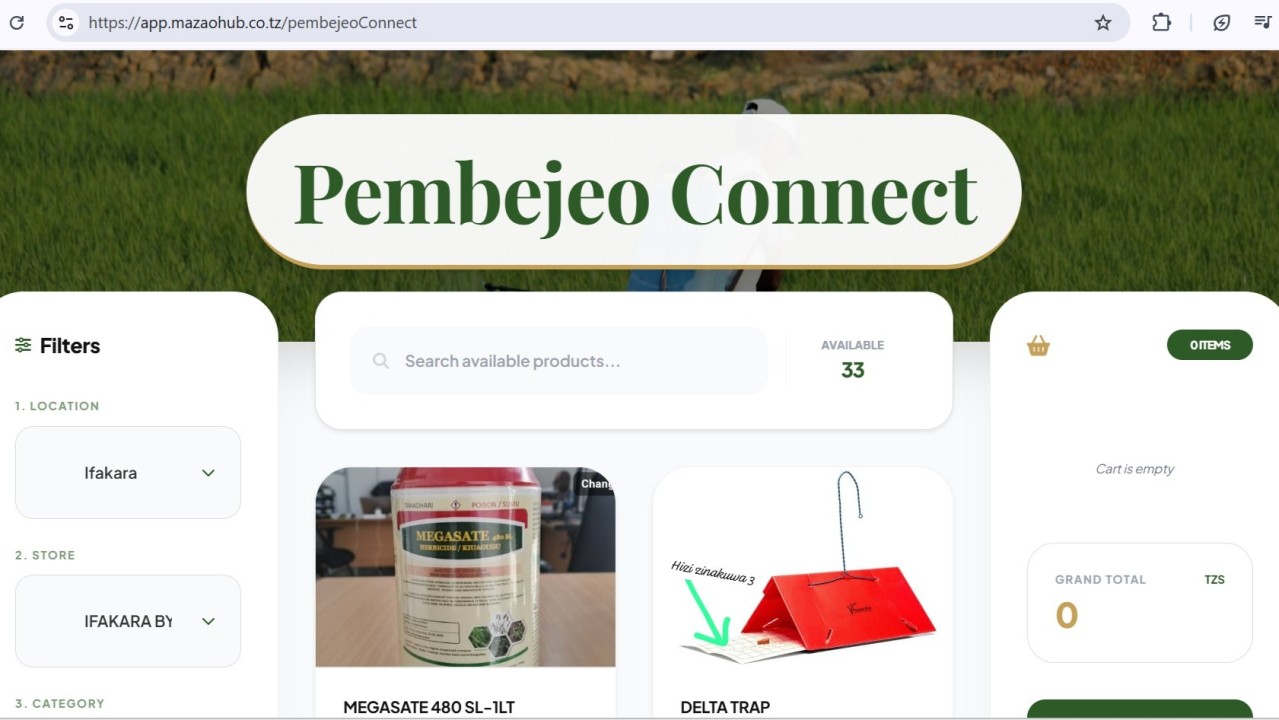
Pembejeo Connect (Inputs Connect) is MazaoHub ’s field-driven ordering and distribution system—available both as a mobile app and a web platform:
Platform link: https://app.mazaohub.co.tz/pembejeoConnect
Pembejeo Connect is not just e-commerce. It is data-driven distribution infrastructure—built around agronomy reality.
The workflow begins with field-based work—either:
This diagnosis is not cosmetic—this is where the economic value begins: it reduces wasted input spending and increases the probability of results.
Based on the diagnosis, MazaoHub generates recommendations—starting with fertilizer, but also including:
Now the critical part: turning recommendations into real access.
Using Pembejeo Connect(MazaoHub App & Web, the extension officer can place an order on behalf of the farmer—quickly, transparently, and with clear product availability.
This eliminates a major barrier: farmers don’t have to “figure it out alone.” They are guided and supported.
Pembejeo Connect routes the order through a network of agrovets and distributors mapped through coordinate points—meaning supply is connected to proximity, not guesswork.
These agro-dealers are organized as a digital network inside the system. We call them partner FECs, because they operate as transformation points in rural agribusiness ecosystems.
To accelerate adoption and standardization across the network, MazaoHub provides partners with:
This reduces their marketing and digitalization costs while increasing sales opportunities. In economic terms, it improves:
Once inputs reach the farmer, MazaoHub continues tracking through the season.
The system collects data on:
This is where agriculture becomes measurable—not only for agronomists, but also for input companies and financiers.
One of the most important discussions at the conference was the future of fertilizer markets in Africa: it will not be shaped only by imports and factories—it will be shaped by data systems that prove performance and optimize distribution.
MazaoHub is building a platform where input companies can, for the first time, see:
This means companies can evaluate field performance—whether it is: OCP, Yara, ETG, Intracom, or any other fertilizer and input brand—based on real usage and outcome signals, not just warehouse movement.
And it is not limited to fertilizer. The same system can track:
This is a major shift: from “distribution and sales” to evidence-based distribution and performance management.
When input distribution becomes data-driven, three transformations become possible:
Farmers stop wasting money on wrong inputs or wrong timing. This increases ROI at farmer level and strengthens repeat purchasing.
Companies distribute based on verified field demand and structured orders—not assumptions. That reduces stockouts, excess inventory, and inefficient logistics.
When inputs are tracked and linked to performance, it becomes easier to:
This is how data becomes a climate tool—not only a business tool.
I’m deeply grateful to the fertilizer industry leaders who invited us into the Argus Fertilizer Africa Conference 2026 space and opened discussions on how we can move Africa toward data-driven production—with measurable outcomes and climate-smart impact.
Every product listed on Pembejeo Connect may look like e-commerce on the surface, but in reality it is a field-driven, analysis-driven distribution and performance system—built to help manufacturers, distributors, transporters, extension networks, and farmers see what is happening, what is needed, and what is working.
I’m looking forward to deeper conversations with all inputs stakeholders on how MazaoHub’s integrated platform can reshape:
Platform: https://app.mazaohub.co.tz/pembejeoConnect
#ArgusFertilizerAfrica2026 #ArgusFertilizerAfrica #MazaoHub #TechAndTouch #DataDrivenAgriculture #FertilizerIntelligence #SoilIntelligence #AgronomyIntelligence #InputsIntelligence #PembejeoConnect #DigitalAgriculture #AgriTechAfrica #SmallholderFarmers #LastMileDistribution #Agrodealers #ExtensionServices #PrecisionAgriculture #ClimateSmartAgriculture #RegenerativeAgriculture #FoodSystems #AgroInputs #Fertilizer #SupplyChain #TradeIntelligence #MarketIntelligence #AgFinance #InclusiveFinance #FarmProductivity #YieldImprovement #AfricaAgriculture

MAZAOHUB PRECISION AGRICULTURE INC.
US OFFICES : State of Delaware, Located at
8 The Green. Ste A, in the City of Dover,
County of Kent, Zip Code : 19901
TANZANIA OFFICES: PSPF Millenium Tower Phase 2,
19th Floor, Bagamoyo Road, Dar es Salaam.

HQ OFFICES : +255 699365987

Monday-Friday (9:00 AM - 5:00 PM)
Saturday and Sunday: Off