Hospitals are built on a simple promise: when life is at risk, we do not “try our luck.” We measure. We diagnose. We prescribe the right dose. We follow up. We keep records. We protect the patient—and the community. That is why, when a child has fever, nobody accepts a nurse who says, “I’m guessing.” We would call it dangerous.
Now be honest: why do we accept guessing in agriculture—the system that feeds us?
In Africa, the reality is brutal. One government extension officer can be expected to support thousands of farmers, and widely cited ratios range from 1:3,000 on average in Africa to 1:5,000–1:10,000 in some contexts. When one person is stretched that thin, most farmers are left unattended. They do what any human would do when abandoned: they improvise. They ask neighbors. They copy what worked “last season.” They use whatever input is available. They increase the dose when the pest refuses to die. They mix products because someone said it is “stronger.” They spray without protective gear because nobody trained them. They harvest without records because nobody is tracking quality.
And then we act shocked when farms fail, when food is unsafe, when soils die, when incomes collapse, and when health risks rise.
Agriculture has been treated like it doesn’t deserve healthcare
We have normalized negligence in farming.
We don’t run hospitals by rumor. But we run farms by rumor every day.
We do not allow a pharmacy to sell random drugs without guidance—yet we often allow “anything” to circulate in input markets: counterfeit products, wrong active ingredients, expired chemicals, and bad advice. The World Health Organization warns that highly hazardous pesticides can cause acute and chronic health effects and have been linked to serious harm and fatalities in many parts of the world—often through occupational exposure and poisonings.
This is not a small issue. This is a public-health issue.
And yes—this is where the conversation gets sensitive, but it must be said: wrong chemical use and wrong dosage can increase poisoning risk and may raise long-term health risks, including cancer risks for some exposures and some substances. Regulators explicitly evaluate pesticide risks across a wide spectrum of effects “from eye and skin irritation to cancer and birth defects.” The science is complex and debated for specific chemicals, but the direction is clear: exposure matters, and misuse increases exposure.
For example, in 2015, the International Agency for Research on Cancer (IARC) classified glyphosate as “probably carcinogenic to humans” (Group 2A), based on limited evidence in humans and sufficient evidence in experimental animals. Other authorities have disagreed with that conclusion, and Germany’s BfR has argued that the IARC finding is based on limited evidence and notes that some large studies did not confirm the association. That disagreement is exactly the point: if experts debate risk at high levels, why are we comfortable letting rural farmers “guess” dosage and mixing in the field with no clinical support?
If we truly care about farmers, families, and consumers, we must stop treating agriculture like a second-class sector.
“Have you ever wondered…?” The farm is also a patient
Have you ever wondered why a farm can receive fertilizer for years and still become weaker?
Have you ever wondered why you spray more every season, yet pests become more stubborn?
Have you ever wondered why yields stay low even when farmers spend more money?
Have you ever wondered why vegetables look perfect but taste empty?
Have you ever wondered why a farmer can work all year and still struggle to pay school fees?
These are not mysteries. They are symptoms.
And symptoms demand a clinic.
A real clinic does four things:
That is exactly what a “Hospital for Farms” should do.
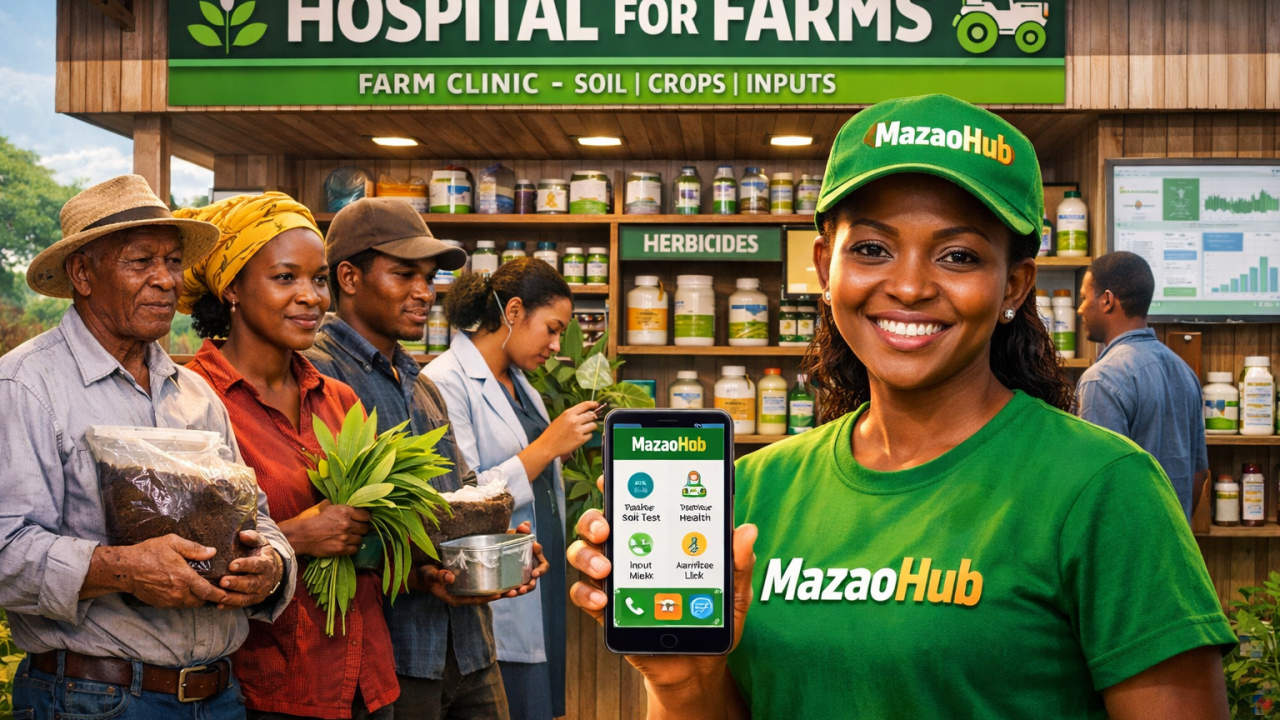
MazaoHub’s answer: Farm Clinics powered by AI, delivered through Tech-and-Touch
MazaoHub is building franchised Farm Clinics—like hospitals, but for soil, crops, and farmer decisions.
Not a “shop.” Not a random agro-input counter. A clinic.
The clinic is where a farmer brings the “patient evidence”: soil samples, crop symptoms, planting dates, input history, and local conditions. Then AI and trained extension officers work together—Tech-and-Touch—to provide clinical agriculture.
1) AI in Soil: stop guessing what the soil needs
Most farmers are spending money on inputs without knowing what their soil is actually missing. That is like buying medicine without diagnosis.
In a Farm Clinic, portable soil kits test key indicators (like pH and nutrient signals), and AI translates the results into simple actions: what to add, what to reduce, what to stop, and what to rehabilitate. This is where the first “hospital principle” starts: measure before you medicate.
When farmers stop blind application, they don’t just save money—they also reduce unnecessary exposure and environmental contamination. That is why international guidance emphasizes managing pesticides across the whole lifecycle and reducing risks, especially where regulation is weak.
2) AI in Agronomy Intelligence: a doctor-like follow-up for crops
Hospitals don’t treat you once and disappear. They follow your case.
MazaoHub’s Agronomy Intelligence works the same way: it tracks the farm season like a patient file—crop stage, field activities, scouting findings, weather risks, and recommended actions. Farmers get follow-ups through clinic visits, SMS, and app guidance.
This is controversial, but true: the biggest reason extension fails is not knowledge—it is continuity. Farmers are not failing because they are lazy; they are failing because nobody is consistently walking with them from land prep to harvest. Farm Clinics make that continuity possible.
3) AI in Input Recommendations: the right product, the right dose, the right time
Let’s talk about dosage, because this is where lives can be harmed.
Wrong dosage can mean:
WHO and FAO emphasize stronger oversight and safer distribution and retailing because unregulated pesticide markets create real population-level risk.
Farm Clinics use AI to recommend inputs and dosage windows more responsibly, aligned with crop stage and field conditions. This is not about “using more chemicals.” It is about precision: doing only what is needed, when it is needed, and tracking results.
4) AI in Supply Chain: clinics forecast demand and block counterfeit inputs
A hospital cannot function if the pharmacy is fake.
MazaoHub’s model tackles one of the most painful problems farmers face: counterfeit or mismatched inputs. Farm Clinics can forecast demand (by village, by crop stage) and connect farmers to verified input suppliers. This reduces panic buying, reduces exploitation, and increases trust.
The chaos in input markets is not accidental—chaos is profitable for someone.
Farm Clinics replace chaos with records, forecasting, and traceability.
5) AI into Harvest and Sourcing: from “I harvested” to “I can sell”
Hospitals don’t just treat—they prepare you to live better afterward.
MazaoHub connects the clinic model to harvest and sourcing through aggregation and platforms like CropSupply.com, so farmers are not abandoned at the finish line. AI helps align expected volumes and quality with buyer requirements, and farmers gain visibility on orders and market signals.
That means fewer post-harvest losses, fewer broken promises, and less exploitation by middlemen who thrive when farmers have no data.
AI doesn’t replace people—it upgrades communities.
Farm Clinics are not “big city laboratories.” They are village-friendly spaces where farmers learn practical decision-making.
Villagers bring samples. They ask questions. They see results. They compare seasons. They understand why a dosage changed. They learn why a soil problem cannot be fixed by “more fertilizer.” They start trusting data—not because someone lectured them, but because they experienced results.
And the extension officers? In this model, they become what they were always meant to be: farm doctors—professionals who interpret evidence, guide actions, and follow up.
A final question
If your child was sick, would you accept “guessing”?
If your mother needed medication, would you accept “trial and error”?
So why do we accept it for the soil that feeds your child and the crops that build your family’s future?
find out more here

MAZAOHUB PRECISION AGRICULTURE INC.
US OFFICES : State of Delaware, Located at
8 The Green. Ste A, in the City of Dover,
County of Kent, Zip Code : 19901
TANZANIA OFFICES: PSPF Millenium Tower Phase 2,
19th Floor, Bagamoyo Road, Dar es Salaam.

HQ OFFICES : +255 699365987

Monday-Friday (9:00 AM - 5:00 PM)
Saturday and Sunday: Off