African agriculture is facing a quiet but accelerating emergency. It is not only a farmer problem. It is a government problem, a food-security problem, an industry problem, an input-market problem, a finance problem, a research problem, and increasingly, a climate-resilience problem.
For decades, many interventions have entered African agriculture with good intentions: farmer trainings, input distribution programs, subsidies, digital advisory tools, donor pilots and projects, public extension reforms, market-access initiatives, and financial inclusion projects. Yet the daily reality of many smallholder farmers has remained painfully unchanged. Productivity is still low. Input losses are still high. Diseases are still spreading. Markets are still uncoordinated. Finance is still difficult. Climate shocks are becoming worse.
The reason is simple but uncomfortable: most interventions have treated symptoms without building the missing infrastructure of farm care.
The first and most dangerous gap is fragmented extension support. In theory, public extension officers exist to guide farmers. In reality, one officer may be expected to support thousands of farmers manually. No single person can diagnose thousands of farms with different soils, crops, diseases, water conditions, weather risks, and market needs. In many rural areas, extension officers lack digital tools, diagnostic equipment, updated protocols, transport, data systems, and accountability mechanisms. Their work is rarely visible, traceable, or performance-based.
As a result, many farmers continue to make decisions through guesswork, neighbor-to-neighbor advice, or pressure from input shops. Climate change is making this weakness more dangerous. Rainfall is shifting. Pests are spreading differently. Diseases are appearing in new areas. Soil degradation is becoming more visible. A farmer who once survived by experience now needs data, diagnosis, and close follow-up.
The second gap is input use without diagnosis. If a patient is sick, no serious health system would ask them to go to a pharmacy, copy another patient’s medicine, guess the dosage, and hope to recover. Yet this is exactly how millions of farmers buy seeds, fertilizers, fungicides, pesticides, and herbicides. Wrong product. Wrong timing. Wrong dosage. Wrong soil. Wrong crop stage. Wrong disease.
This is expensive for farmers, dangerous for the environment, and damaging for legitimate input manufacturers. When inputs are misused, farmers lose trust. When fake or wrongly handled products reach the last mile, responsible brands suffer. When chemicals are applied blindly, soils, water systems, ecosystems, and human health are put at risk.
The third gap is unresolved pests and diseases. Across many crops, farmers are seeing field problems that do not respond easily to the usual treatments. In Tanzania, MazaoHub is hearing from more than 75,000 rice farmers across various villages who are struggling with persistent yellowing symptoms. They have tried many treatments, consulted different officers, and spent money season after season, yet answers remain weak.
This is not just a farmer complaint. It is a scientific signal. Farms are becoming like patients with chronic conditions. Without localized research, soil-water-crop analysis, pest identification, disease diagnosis, treatment trials, and field-level monitoring, farmers will continue applying more inputs into failing systems.
The fourth gap is market invisibility. Food companies, processors, exporters, and governments need reliable crop supply. But how can an industry coordinate 50,000 metric tons from 5,000 farmers if it does not know who is producing what, where, how, in what quantity, under which agronomic conditions, and with what expected quality?
This is why many processors still import crops that African farmers could produce. Not because farmers are unwilling, but because the system around them is invisible.
MazaoHub exists to close these gaps.
MazaoHub is building Farm Care Infrastructure through a “Hospital for Farms” model. Every farm becomes visible. Every farmer is connected. Every extension officer is digitally supported. Every input recommendation is linked to diagnosis. Every market opportunity is backed by data. Every field problem can be escalated into research.
The model has three integrated layers.
First, MazaoHub produces and deploys farm diagnosis tools, including portable and solar-powered soil sensors, soil testing kits, and field diagnostic workflows. These tools help farmers understand what is happening beneath the soil and inside the farm before money is spent on inputs.
Second, MazaoHub has built an agronomy software backbone: Farm ERP, Virtual Agronomist, Crop Calendar AI, Farm Clinic OS, disease reporting tools, prescription workflows, and intelligence dashboards. Every farm becomes a living care record, capturing farmer identity, GPS location, farm maps, soil status, crop history, pest and disease signals, input use, prescriptions, financial records, weather information, market readiness, and outcomes.
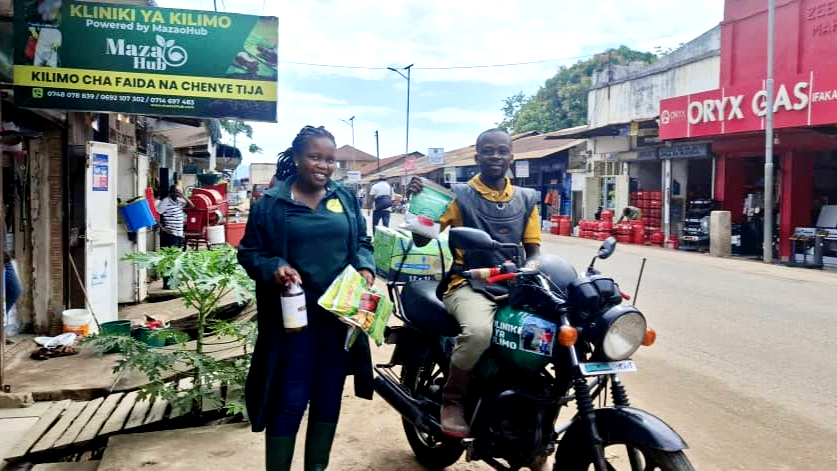
Third, MazaoHub transforms last-mile agrovets, rural agribusinesses, cooperatives, warehouses, farmer groups, and extension officers into franchised Farm Clinics. These clinics become the rural front door of farm care, just as local clinics serve patients before referral hospitals handle complex cases. When farm problems become more serious, they can be escalated to research institutions and scientific partners.
This creates a new operating system for agriculture. Every farmer is connected to an extension officer. Every extension officer is connected to Farm Clinics, agrovets, fellow officers, research protocols, and input suppliers. Every input order can be linked to a recommendation. Every disease report can become structured data. Every unresolved field problem can become a research question. Every actor becomes more visible, measurable, and accountable.
The opportunity is massive.
If scaled across Africa, MazaoHub’s model could realistically reach 45–50 million farmers, activate more than 50,000 Farm Clinics and last-mile care points, and create over 75,000 on-demand extension jobs, especially for young agronomists, women graduates, rural youth, trained government officers, and women-led agribusinesses. If each farmer represents a household of five people, this becomes a livelihood pathway for more than 225–250 million family members.
Beyond Africa, the same model can expand into smallholder-dense regions of Asia and Latin America, reaching 70–100 million farmers over the next decade and touching 350–500 million people across farming households.
This is not expansion by building expensive branches country by country. It is expansion by converting what already exists into a connected care system.
Every agrovet can become a Farm Clinic. Every extension officer can become digitally amplified. Every farmer group can become a data-backed production cluster. Every distributor can understand real demand. Every input manufacturer can measure product performance. Every bank can see farm records before lending. Every insurer can price risk better. Every government can track subsidy impact. Every factory can source with confidence. Every research institution can receive real field problems instead of delayed reports.
For governments, this unlocks stronger extension systems, better subsidy targeting, youth employment, climate-smart planning, and national food-security intelligence.
For research institutions, it unlocks direct access to real field problems and faster channels to take scientific solutions back to farmers.
For input companies, it unlocks safer input use, demand forecasting, farmer trust, counterfeit visibility, and product-performance intelligence.
For banks and insurers, it unlocks visible, traceable, finance-ready farmers.
For industries and exporters, it unlocks structured sourcing, traceability, quality visibility, local processing, import substitution, and export growth.
For youth and women, it unlocks dignified work as extension officers, Farm Clinic operators, soil technicians, data officers, crop scouts, and agribusiness service providers.
Africa does not only need more inputs. It needs diagnosis. It does not only need more extension officers. It needs digitally amplified extension. It does not only need more markets. It needs traceable production. It does not only need more research. It needs research connected to real farmer pain.
MazaoHub is building the infrastructure to make that possible.
The farmer is already there. The agrovet is already there. The extension officer is already there. The buyer is already there. The bank is already there. The insurer is already there. The government is already there.
The missing piece is the operating system that connects them around the farm.
This is why MazaoHub is now calling for partners.
We are calling governments, ministries of agriculture, agricultural boards, county and regional authorities, and public & private extension departments. MazaoHub does not come to replace government systems. We come to strengthen them. We bring a proven operating model that can make public extension more visible, more coordinated, more data-driven, and more accountable. A country does not need to start from zero. It does not need to spend years building new infrastructure before impact begins. MazaoHub arrives with a tested model, technology, field protocols, Farm Clinic systems, extension workflows, and market linkages that can be adapted quickly to local realities.
We are calling agrovets, input dealers, rural agribusinesses, cooperatives, farmer groups, warehouses, and last-mile distributors. These actors are already close to farmers. They already have trust, location, relationships, and local knowledge. MazaoHub helps transform them into Farm Clinics — profitable, data-driven, science-backed service points offering soil testing, prescriptions, agronomy support, input ordering, crop monitoring, finance linkage, insurance connection, and market access. They do not need to become technology companies. MazaoHub gives them the system.
We are calling wholesale distributors, importers, seed companies, fertilizer companies, pesticide companies, herbicide companies, and manufacturers. The future of input business is not only selling more products. It is knowing where products are needed, why they are needed, how they are used, whether they worked, and what farmers experienced after using them. MazaoHub creates this visibility. It helps responsible companies build farmer trust, protect their brands, reduce misuse, identify fake products, forecast demand, and understand product performance from village to national level.
We are calling banks, microfinance institutions, SACCOs, development finance institutions, and agricultural lenders. Farmers have been called risky for too long, but many are risky because they are invisible. When a farmer has a farm profile, GPS location, soil record, crop plan, input history, extension follow-up, expected yield, market linkage, and repayment behavior, lending becomes more practical. MazaoHub turns farmers and agribusinesses into finance-ready clients. This can unlock seasonal loans, input credit, equipment finance, working capital for agrovets, and structured financing for farmer groups.
We are calling insurance companies and climate-risk partners. Agricultural insurance becomes difficult when farms are unknown, crops are not mapped, and field conditions are not verified. MazaoHub brings the missing data layer. When farms are mapped, crop stages are recorded, weather information is connected, soil conditions are known, and extension officers can verify field events, insurance becomes more workable, more trusted, and more scalable. Farmers can move from facing climate risk alone to being protected through data-backed insurance products.
We are calling research institutions, universities, national agricultural research systems, CGIAR centers, plant health experts, soil scientists, irrigation specialists, seed breeders, and crop protection researchers. Farmers are facing real problems every day, but many of those problems never reach research institutions in a structured way. MazaoHub can change that. Every Farm Clinic can become a listening post for science. Every disease report can be geo-tagged. Every pest outbreak can be classified. Every soil challenge can be recorded. Every unresolved case can be escalated. Research can move faster from laboratory to farm, and farmer pain can move faster from farm to science.
We are calling food companies, processors, exporters, hotels, aggregators, traders, and industrial buyers. Africa cannot build strong agro-industries on invisible production. MazaoHub makes farmer production visible before harvest. Buyers can know where crops are, who is producing, what quantity is expected, what quality pathway is followed, and how sourcing can be coordinated. This opens doors for local processing, import substitution, export growth, and stronger rural incomes.
The most important point is this: when MazaoHub enters a country, we are not asking every partner to carry heavy upfront costs. We come as a private company with a shared-value operating model that has already been tested at scale in Tanzania. Governments do not need to build the system from scratch. Agrovets do not need to develop software. Banks do not need to create farm records manually. Insurers do not need to search blindly for field data. Research institutions do not need to wait for scattered reports. Input companies do not need to guess last-mile demand. Buyers do not need to gamble with invisible production.
MazaoHub brings the operating infrastructure.
The country brings its farmers, institutions, markets, officers, agrovets, distributors, banks, insurers, researchers, and industries.
Together, we connect them.
This is how a country can be transformed.
Extension becomes coordinated. Farmers become visible. Agrovets become Farm Clinics. Youth become on-demand extension officers. Women become service providers and agribusiness leaders. Inputs become recommendation-led. Subsidies become traceable. Loans become data-backed. Insurance becomes practical. Research becomes connected to real farmer pain. Factories receive more reliable raw materials. Exporters access better production visibility. Governments gain food-security intelligence. Farmers move from guessing to farming with confidence.
This is not a donor-dependent model that ends when a project ends. It is a commercial and partnership-driven infrastructure that grows because every actor benefits. Farmers receive better care. Agrovets earn more. Extension officers get more productive work. Input companies sell more responsibly. Banks find better clients. Insurers manage risk better. Buyers source more confidently. Governments see more clearly. Research institutions solve real problems faster.
MazaoHub is inviting countries and partners to join a movement that can change the foundation of agriculture.
If you are a Minister of Agriculture, Permanent Secretary, Director of Extension, agricultural board leader, research institution, agrovet, distributor, input manufacturer, bank, insurer, food company, exporter, cooperative, farmer organization, development partner, investor, or young African who wants to help transform agriculture in your country — we would be honored to speak with you.
Africa has been blessed with land, farmers, youth, water systems, biodiversity, and agricultural potential that the world cannot ignore. But potential alone will not us. Potential must be organized. Potential must be supported. Potential must be financed. Potential must be protected. Potential must be connected to science, data, markets, and care.
That is what MazaoHub is building.
A new agricultural infrastructure for smallholder countries. A shared operating system for governments and private partners. A practical pathway from soil diagnosis to market access. A bridge between science and the farmer. A future where farming is no longer a gamble.
Join us today. My email is shared below.
info@mazaohub.com
#MazaoHub #TheMissingInfrastructure #FarmCareInfrastructure #HospitalForFarms #AfricanAgriculture #SmallholderFarmers #FarmingIsNotAGamble #DataDrivenAgriculture #PrecisionAgriculture #DigitalAgriculture #ClimateSmartAgriculture #FoodSecurity #AgritechAfrica #FarmersFirst #ExtensionServices #YouthInAgriculture #WomenInAgriculture #AgriFinance #CropInsurance #InputStewardship #TraceableAgriculture #MazaoHub #FarmClinic #AfricaRising #FutureOfFarming #AgricultureTransformation

MAZAOHUB PRECISION AGRICULTURE INC.
US OFFICES : State of Delaware, Located at
8 The Green. Ste A, in the City of Dover,
County of Kent, Zip Code : 19901
TANZANIA OFFICES: PSPF Millenium Tower Phase 2,
19th Floor, Bagamoyo Road, Dar es Salaam.

HQ OFFICES : +255 699365987

Monday-Friday (9:00 AM - 5:00 PM)
Saturday and Sunday: Off